
Natalia Kardash
Chile and Peru -
a Journey to the Edge of the World
a Journey to the Edge of the World
Exploration Voyage with Swan Hellenic from Valparaiso to Lima
30 March - 8 April 2026
30 March - 8 April 2026

This is our plan:
we boarded SH Vega in Chile and the ship went all the way along the shores of two countries.
we boarded SH Vega in Chile and the ship went all the way along the shores of two countries.
We, my daughter Kate and I, were travelling in Chile and Peru on an expedition cruise with Swan Hellenic – a company that focuses on thoughtful travel, not mass tourism. On board, there are scientists, experts, and people who want to understand the world around.
For me, this is not just a holiday. It is part of a long personal journey – to see with my own eyes the places I once imagined while reading books.
When I was a child, I read all books of Jules Verne, and "Les Enfants du capitaine Grant" was my favorite. (Its English title "In Search of the Castaways" does not say anything to a Russian-speaking person - in our language it is translated from the original - "Children of Captain Grant".)
From this book I remember the detailed landscapes of Andes, Verne's imagination was so well described that it seems to me that I have been there myself. I also watched many movies. And now, finally, I could see these two wonderful countries - Chile and Peru. This was my first visit to South America.
For me, this is not just a holiday. It is part of a long personal journey – to see with my own eyes the places I once imagined while reading books.
When I was a child, I read all books of Jules Verne, and "Les Enfants du capitaine Grant" was my favorite. (Its English title "In Search of the Castaways" does not say anything to a Russian-speaking person - in our language it is translated from the original - "Children of Captain Grant".)
From this book I remember the detailed landscapes of Andes, Verne's imagination was so well described that it seems to me that I have been there myself. I also watched many movies. And now, finally, I could see these two wonderful countries - Chile and Peru. This was my first visit to South America.
“The scenery was magnificent; the mountains were grand beyond description.”

Charles Darwin,
from his travel writings (Voyage of the Beagle, 1839), describing Chilean landscapes.
from his travel writings (Voyage of the Beagle, 1839), describing Chilean landscapes.
1839
1
Overview of the Cruise
SH VEGA of Swan Hellenic took its passengers from the vibrant city of Valparaíso, Chile, and this cruise was concluded in Callao (Lima) in Peru. This voyage took us along the stunning coasts of South America, allowing to explore rich cultural diversity and breathtaking landscapes of the region. We had an opportunity to visit several locations such as Coquimbo with its ancient geoglyphs, Arequipa known by Inca culture, Iquique with its famous industrial past and many other places I am telling you about on this page. This is a travel journey to highlight Swan Hellenic cruise and all my experience related to it.
Another exciting fact (for me it is an important addition) Swan Hellenic is a partner of the SETI Institute. This is a space and earth science research organisation that supports NASA, NSF (National Science Foundation), private industry and academia in answering some of humanity's most profound questions. In this trip scientists shared expert insights into the history and latest discoveries in astronomy, astrophysics, astrobiology and planetary science.
This journey took place in cooperation with Swan Hellenic. That is why I was paying close attention not only to the countries, cities and excursions, but also to the expedition cruise format itself: what the traveller receives, how it differs from a usual cruise, and what it means - an expedition cruise. For me - ideal format, and I explain why.
Another exciting fact (for me it is an important addition) Swan Hellenic is a partner of the SETI Institute. This is a space and earth science research organisation that supports NASA, NSF (National Science Foundation), private industry and academia in answering some of humanity's most profound questions. In this trip scientists shared expert insights into the history and latest discoveries in astronomy, astrophysics, astrobiology and planetary science.
This journey took place in cooperation with Swan Hellenic. That is why I was paying close attention not only to the countries, cities and excursions, but also to the expedition cruise format itself: what the traveller receives, how it differs from a usual cruise, and what it means - an expedition cruise. For me - ideal format, and I explain why.
Funny Maps - New Geography by AI
I asked ChatGPT, Perplexity and Gemini to draw a map in Jules Verne's style to show the route. With the same text of guidance we got three versions. Enjoy finding mistakes, and looking at different versions of reality. All three AI-chats are very creative in changing the world map. Gemini is the winner (1st left - most correct), then Perplexity that placed Athens in the Middle East and Larnaca above India, the last is ChatGPT where Lima and Madrid are in the ocean, Athens in Italy, Santiago in Peru.
2
Larnaca to Santiago,
Lima to Larnaca
Lima to Larnaca
Chile is far from Cyprus where I live. But the trip to Santiago was not as complicated as it may seem.
On my way to the South America I had to fly from Larnaca to Athens, then in a couple of hours – to Madrid. There I met Kate who lives in London, she had an easy direct flight. From there, together, we had a direct flight to Santiago. After a private city tour we went to Valparaíso, the port of departure.
The cruise ship took us from Chile to Lima in Peru. From there we flew back to Europe. I stayed for a day in Madrid, time to rest and go around the city centre. Then it was a short flight to Athens, and, in a couple of hours, the shortest of all – a flight from Athens to Cyprus.
It sounds long. But in reality, it is very manageable. The key is simple: one step at a time.
On my way to the South America I had to fly from Larnaca to Athens, then in a couple of hours – to Madrid. There I met Kate who lives in London, she had an easy direct flight. From there, together, we had a direct flight to Santiago. After a private city tour we went to Valparaíso, the port of departure.
The cruise ship took us from Chile to Lima in Peru. From there we flew back to Europe. I stayed for a day in Madrid, time to rest and go around the city centre. Then it was a short flight to Athens, and, in a couple of hours, the shortest of all – a flight from Athens to Cyprus.
It sounds long. But in reality, it is very manageable. The key is simple: one step at a time.
3
Madrid airport – a small adventure
Madrid airport deserves a separate mention. It is huge. Really huge.
I walked for a very long time from arrival to baggage claim, went out to the main airport hall and - in search for the departure area - I walked quite a lot. When I finally found a row of TV screens showing departures, I did not find my flight there.
I took a deep breath, calmed myself down. OK... It might be a wrong terminal. Look again. I carefully looked through all the lines, all Terminals (1, 2, 3). The flight was not there.
I walked for a very long time from arrival to baggage claim, went out to the main airport hall and - in search for the departure area - I walked quite a lot. When I finally found a row of TV screens showing departures, I did not find my flight there.
I took a deep breath, calmed myself down. OK... It might be a wrong terminal. Look again. I carefully looked through all the lines, all Terminals (1, 2, 3). The flight was not there.
I started to panic. What if I missed something, made a mistake? What if I arrived from Athens to one airport, and my next flight would depart from another one, somewhere on the other side of the city?
While I was looking for my tickets, then comparing the names of airports, I got quite nervous. But no – luckily, it was the same airport. Then where was my flight?! Why was it not on the TV screens? I look carefully. Not in Terminal 1, not in Terminal 2, not in Terminal 3.
My ticket said Terminal 4S, but there were no signs for it anywhere, there are only three terminals on the screen and on the signs around. Luckily, I met a police officer who spoke English. We checked my ticket together and he explained how to find this terminal - "walk, take a lift, walk, take an escalator, go outside, take a bus"... (If you fly through Madrid in transit, allow more time than you think you need. I am glad I had four hours!)
—
I finally reached Terminal 4 and checked in my luggage. And – surprise! – that was not the end. Now I had to take a train to a separate building. About 200 metres across the hall, then a long and slow descent on escalators down four levels, then wait for the train, five minutes on the train, and again escalators – another five minutes to reach the entrance of this satellite terminal. It is called T4S.
In the end everything worked perfectly. Reading about my little adventure, my friend Anna, who travels a lot, said she might prepare a guide on various airports. I hope she'll do it, I'll be its first reader. It might be so useful!
My conclusion is simple: if you are flying via Madrid do not plan a short connection. Even if it is the same airport, getting from one terminal to another can take much longer than you may expect.
While I was looking for my tickets, then comparing the names of airports, I got quite nervous. But no – luckily, it was the same airport. Then where was my flight?! Why was it not on the TV screens? I look carefully. Not in Terminal 1, not in Terminal 2, not in Terminal 3.
My ticket said Terminal 4S, but there were no signs for it anywhere, there are only three terminals on the screen and on the signs around. Luckily, I met a police officer who spoke English. We checked my ticket together and he explained how to find this terminal - "walk, take a lift, walk, take an escalator, go outside, take a bus"... (If you fly through Madrid in transit, allow more time than you think you need. I am glad I had four hours!)
—
I finally reached Terminal 4 and checked in my luggage. And – surprise! – that was not the end. Now I had to take a train to a separate building. About 200 metres across the hall, then a long and slow descent on escalators down four levels, then wait for the train, five minutes on the train, and again escalators – another five minutes to reach the entrance of this satellite terminal. It is called T4S.
In the end everything worked perfectly. Reading about my little adventure, my friend Anna, who travels a lot, said she might prepare a guide on various airports. I hope she'll do it, I'll be its first reader. It might be so useful!
My conclusion is simple: if you are flying via Madrid do not plan a short connection. Even if it is the same airport, getting from one terminal to another can take much longer than you may expect.
4
Arrival in Santiago
– first impressions
– first impressions
We arrived in Santiago early in the morning. A private guide met us at the airport, and we immediately started exploring the city by car. We only had a few hours, so this was the best decision - driving around we could see a lot, talking to a native we could learn about the life of people here, about their history and culture.
Santiago is a city of contrasts. Wide, clean, very green streets and parks in the modern districts. Classical buildings, government quarters, and the presidential palace in the historical centre. Small very old houses in the poor districts.
The city's name means “Saint James”. It was founded in 1541 by Pedro de Valdivia. From this point, it slowly grew into one of the largest cities in South America, with more than 7 million people.
The climate here is very familiar for those who live in Cyprus – dry and hot summers, mild winters.
But the setting is completely different.
The Andes mountains rise above the city. In winter they are fully covered with snow. Now, after summer, only the glaciers remain on the peaks.
This mountain chain separates Chile from Argentina. You may have heard the word “Cordillera” – here it becomes real.
The climate here is very familiar for those who live in Cyprus – dry and hot summers, mild winters.
But the setting is completely different.
The Andes mountains rise above the city. In winter they are fully covered with snow. Now, after summer, only the glaciers remain on the peaks.
This mountain chain separates Chile from Argentina. You may have heard the word “Cordillera” – here it becomes real.
“Nothing can be compared with the majestic grandeur of the Cordilleras.”

Jules Verne,
in the book "In Search of the Castaways"
(Les Enfants du Capitaine Grant)
in the book "In Search of the Castaways"
(Les Enfants du Capitaine Grant)
1868
Nine Short Facts about Santiago History and Culture
- 12 000 years agoIt is proofed that people lived in the Santiago basin from at least the 10th millennium BC.
- Built on Inca's settlementResearchers think that below Santiago's Plaza de Armas should be an ancient Inca urban centre
- From 1541The city was planned around Plaza de Armas, following the Spanish colonial grid model.
- 300 meters highGran Torre Santiago is the city’s most visible modern landmark - the tallest completed building in South America.
- 1 635 metersabove the sea level - this is the highest point of Sangiago. But most of the city is on the hight between 400 and 700 meters
- Many HillsSantiago has 26 “island hills”, known as cerros isla. They look like green islands.
- CuecaThis is the Chile’s national courtship dance: a man and a woman circle each other, move closer, retreat and wave handkerchiefs.
- FoodTypical city food in Santiago: completo, chacarero, empanada de pino and terremoto.
- Drink to TrySantiago’s funniest drink is called terremoto, meaning “earthquake”. It is usually made with young white pipeño wine and pineapple ice cream.


















Cerro Santa Lucía is not just a simple park. This is the exact place where Santiago began. In the 19th century, the hill was transformed into a landscaped park: terraces, staircases and decorative structures were added, giving it a very European feel.
The most visible building is Castillo Hidalgo. We immediately fell in love with it!
The most visible building is Castillo Hidalgo. We immediately fell in love with it!
It was built in 1816 as a fortress. Later it was used as a warehouse and administrative building. Today it is a venue for events, with one of the best views over the city.
We also visited a tower on the top of this hill. Originally, it was part of the defensive system, from here the whole then town (now big city) is visible. The view is perfect - you can see Santiago from above. Unfortunately, due to morning fog, you can not see the mountains well.
We also visited a tower on the top of this hill. Originally, it was part of the defensive system, from here the whole then town (now big city) is visible. The view is perfect - you can see Santiago from above. Unfortunately, due to morning fog, you can not see the mountains well.
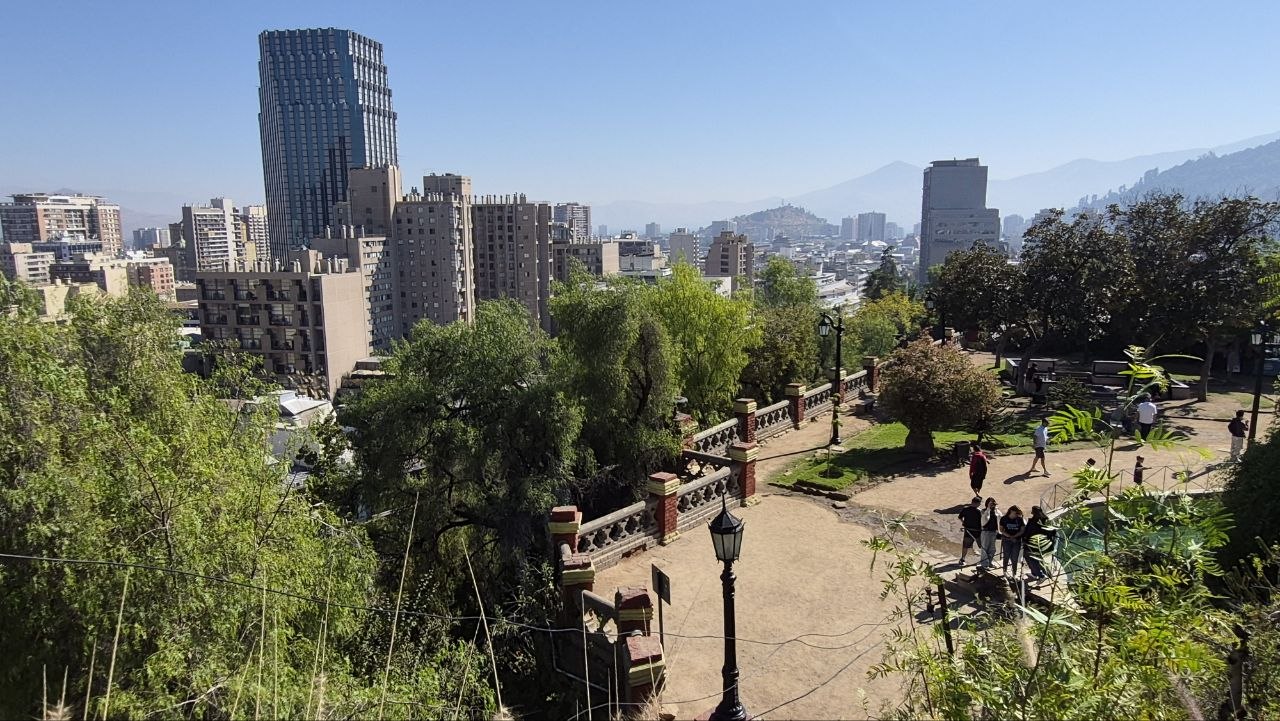
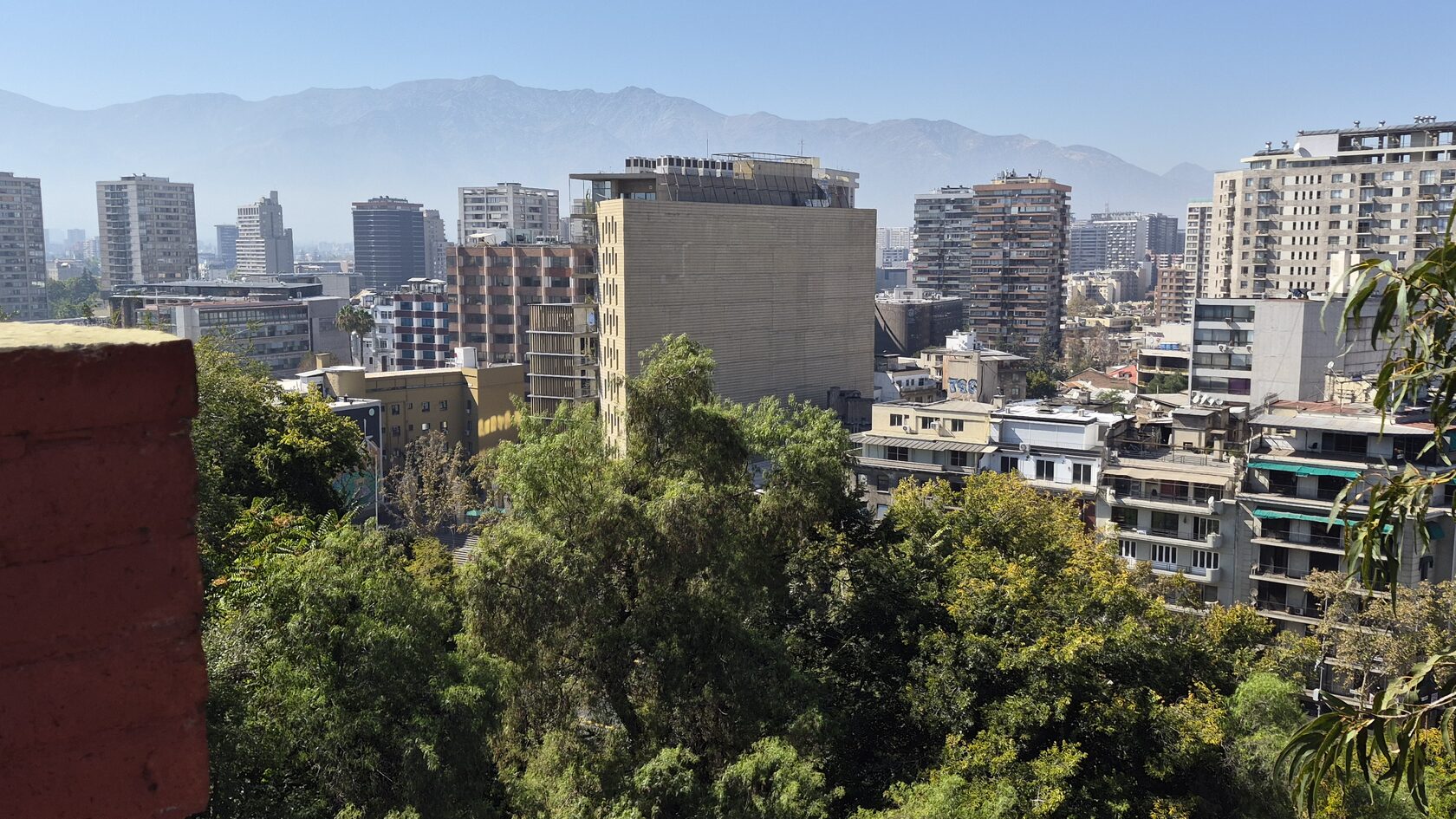

Panoramic View of Santiago framed by the Andes and the Chilean Coast Range. You can see that this city is surrounded by very high mountains.
The photo is not mine, taken from Wikimedia. Photographer: José Porras
The photo is not mine, taken from Wikimedia. Photographer: José Porras
We spent half a day exploring Santiago, drove, walked a bit and left the city to go to the shore of the ocean. Our destination is Valparaiso, the biggest port city of Chile.
On the way we visited Viña del Mar — the seaside city that is commonly treated as Valparaiso's polished tourist counterpart, with beaches, hotels, parks and a resorts.
It is also known as the “Garden City”, a nickname earned by its parks, gardens and carefully cultivated urban landscape.
It is one of Chile’s classic summer capitals - for decades people from Santiago and other cities come here for holidays.
It is also known as the “Garden City”, a nickname earned by its parks, gardens and carefully cultivated urban landscape.
It is one of Chile’s classic summer capitals - for decades people from Santiago and other cities come here for holidays.

This is our guide Julio (photo below) who loves his country and knows a bit about everything and the car that took us around for the whole day. Behind Julio you see one of the famous sculptures from Easter island. It was brought here by a ship. Easter Island is part of Chile, by the way. But it is very far: a direct flight from Santiago takes about five and a half hours.
On the third picture below you see one of the most known building of Viña del Mar built in a style of the casino in Monte Carlo.
On the third picture below you see one of the most known building of Viña del Mar built in a style of the casino in Monte Carlo.
5
Valparaiso: street art and colours
The biggest port of Chile is known by its murals. We walked a lot and enjoyed the street art of Miraflores area.
Valparaíso grew up on steep hills, so the city developed vertically. That is why it feels less like a planned urban area and more like a maze of staircases, viewpoints, funiculars and improvised beauty.
It is important. They say that in Valparaíso walls do not simply decorate the city – they explain it. Graffiti and murals became a way for residents to express politics, humour, memory and frustration.
No. Long before visitors came for photos and colourful hills, Valparaíso was one of the most important ports on the Pacific coast. Its wealth came from trade, ships and migration. Now Valparaiso has its second life as a tourist destination.
The Port plays an important role here
This was our view at night from the hotel window
I woke up early to enjoy the warm light of the sunrise
6
Quest to get to the Port

A beautiful start of the day
We woke up early on the day of departure. The plan was simple: have breakfast at the hotel and enjoy one more short walk through the streets of Valparaíso before heading to the port.
The cool morning air made the city feel especially pleasant. Most of the little shops and cafés were still closed, so we wandered quietly through the streets, studying the graffiti and once again admiring the extraordinary imagination of the people who live here.
Eventually, we found a small cosy café, and treated ourselves to a slice of cake and a cup of coffee. It felt like a gentle pause before the journey truly began.
Below you'll see more photos of Valparaiso walls, houses, streets.
The cool morning air made the city feel especially pleasant. Most of the little shops and cafés were still closed, so we wandered quietly through the streets, studying the graffiti and once again admiring the extraordinary imagination of the people who live here.
Eventually, we found a small cosy café, and treated ourselves to a slice of cake and a cup of coffee. It felt like a gentle pause before the journey truly began.
Below you'll see more photos of Valparaiso walls, houses, streets.

From our room we could see the whole Valparaiso Bay
At last, it was time to go to the port. New passengers usually arrive at the ship at one or even two in the afternoon, so that was our plan as well.
The day before, our guide had shown us where the port was and warned us that, because of roadworks, getting there would not be straightforward. We would have to make a significant detour. So we were prepared for some inconvenience.
What made us slightly worried was the fact that we still had not seen our ship. The windows of our room overlooked the ocean, and from there we had a full view of the bay. Everything was visible except our vessel. No sign of SH Vega. We decided to leave a little earlier than necessary, just in case something unexpected happened and we had to search for where the ship had actually docked.
The day before, our guide had shown us where the port was and warned us that, because of roadworks, getting there would not be straightforward. We would have to make a significant detour. So we were prepared for some inconvenience.
What made us slightly worried was the fact that we still had not seen our ship. The windows of our room overlooked the ocean, and from there we had a full view of the bay. Everything was visible except our vessel. No sign of SH Vega. We decided to leave a little earlier than necessary, just in case something unexpected happened and we had to search for where the ship had actually docked.
A taxi from the hotel cost almost twice as much as one booked through the Uber app, so we trusted technology. Within five minutes, we were already in the car - it showed that the way to the port will take 10 minutes. I decided to film our drive from the hotel to the port so that you could see the contrasts of Valparaíso with your own eyes. One moment it is bright and beautiful, the next grey and neglected; at times cheerful, at times deeply melancholic. In this city, everything exists side by side.
It was a very foggy morning, but you'll still see a lot. Watch my little video.
It was a very foggy morning, but you'll still see a lot. Watch my little video.
On the way to the port
4K Timelapse Video

This is a google view of this place
We drove along the seafront, the driver following the navigator with absolute confidence. As we finally seemed to be turning towards the port, I stopped filming. We had arrived, I thought. ...But not at all!
The driver stopped on a deserted square and with signs showed to us that we arrived. We should get out.
Kate and I stared at the surroundings in disbelief. There were metal fences on all sides, no sign of a terminal, no sign of a ship, and almost no people around. In fact, the place felt so empty and unwelcoming that it was rather frightening. The only visible signs of life were two people standing at a bus stop some distance away.
The driver stopped on a deserted square and with signs showed to us that we arrived. We should get out.
Kate and I stared at the surroundings in disbelief. There were metal fences on all sides, no sign of a terminal, no sign of a ship, and almost no people around. In fact, the place felt so empty and unwelcoming that it was rather frightening. The only visible signs of life were two people standing at a bus stop some distance away.
We were lost
on the way
to the cruise terminal
on the way
to the cruise terminal
We asked the driver to go over to them and find out where the cruise terminal was. He did. They had no idea. It was strange... Where are we?
That was the moment when the situation began to feel genuinely unsettling. Were we even in the right port? Had we misunderstood something? Had the app taken us to the wrong place altogether? The driver was already impatient – as far as he was concerned, he had completed the ride. But we refused to get out. We kept asking him to help us sort it out. It was not easy.
He did not speak English, and Kate and I had to gather all Spanish words we have ever heard plus all our talent for gestures and improvised explanation. We tried to make one thing very clear: we needed to find someone who actually knew where the port was. We were not stepping out of the car here. Absolutely not!
It is a pity I did not take a photograph to show you the scene. I am certain you would not have got out either. But at that moment, photography was the last thing on my mind. We first had to understand where on earth we are – and what to do next.
That was the moment when the situation began to feel genuinely unsettling. Were we even in the right port? Had we misunderstood something? Had the app taken us to the wrong place altogether? The driver was already impatient – as far as he was concerned, he had completed the ride. But we refused to get out. We kept asking him to help us sort it out. It was not easy.
He did not speak English, and Kate and I had to gather all Spanish words we have ever heard plus all our talent for gestures and improvised explanation. We tried to make one thing very clear: we needed to find someone who actually knew where the port was. We were not stepping out of the car here. Absolutely not!
It is a pity I did not take a photograph to show you the scene. I am certain you would not have got out either. But at that moment, photography was the last thing on my mind. We first had to understand where on earth we are – and what to do next.
Then, fortunately, I noticed a new character entering the scene. A man in uniform stepped out of a nearby car. He looked like a guide, or at least someone who might actually know what was going on. We drove up to him and asked for help. At last, a clear answer: we needed to go to the closed gate in the corner and explain that we were heading to a cruise ship. They would let us through.
And that, finally, proved to be true.
We found the gate, guarded and firmly shut. The security officer confirmed that this was indeed the road to the cruise terminal and even gave our driver detailed instructions so that he would not get lost again. Then we drove on for quite a long time through the port area, past old buildings, empty lots and stretches of land that looked almost abandoned. At last, we found the terminal.
And that, finally, proved to be true.
We found the gate, guarded and firmly shut. The security officer confirmed that this was indeed the road to the cruise terminal and even gave our driver detailed instructions so that he would not get lost again. Then we drove on for quite a long time through the port area, past old buildings, empty lots and stretches of land that looked almost abandoned. At last, we found the terminal.
What a relief. Thank God!
By that point, the driver no longer felt like a stranger bringing us from one address to another. We had been through an adventure together, so we said goodbye with genuine warmth and gratitude. Then we stepped inside the terminal.
And found it almost completely empty.
For a second, the same terrible thought returned: had we come to the wrong place again? We walked up to the Info Desk. This time, thankfully, it really was the right place. They knew the name of our cruise company and calmly led us to a waiting bus. We turned out to be its only passengers, which only added to the strange, dreamlike feeling of the whole port ride. So off we went again, now deeper into the port.

We were the only passengers
This video will show to you the port of Valparaiso. It is huge. The biggest port of Chile, you'll see only tiny part. It was so foggy that we could not see ships, but we believed that in this surrealistic world we'll find our ship. We were joking that if we believe in its existence, we'll finally find it...
And then, like a miracle, we saw it at last.
Ahead of us, through the mist, appeared our ship. At the gangway stood smiling crew members, already reaching for our suitcases. Suddenly there were greetings, warm faces, glasses of champagne, and that wonderful instant when anxiety dissolves all at once. We had arrived.
And then, like a miracle, we saw it at last.
Ahead of us, through the mist, appeared our ship. At the gangway stood smiling crew members, already reaching for our suitcases. Suddenly there were greetings, warm faces, glasses of champagne, and that wonderful instant when anxiety dissolves all at once. We had arrived.
Long drive through the port
Valparaíso is a Chilean Pacific port. Its passenger terminal (that is not under reconstruction) covers 10,200 square metres, including a 4,200-square-metre building and 6,000 square metres of parking. The port handled 926,860 TEUs in 2025.
7
Boarding the ship
This was our cruise ship, the place that would be our home for the next ten days. The contrast with everything we had seen during the previous half-hour was so striking that, exhausted by the tension of it all, we could do little more than smile happily as we rode the lift up to our deck. We were shown to our cabin, where our luggage had already been delivered, and then invited to lunch.
Look at the wonderful view to Valparaiso. The fog has gone. The sun showed the best parts of the city - from water it looks decent, and the port does not look strange anymore. It was just a dream, and now we are back to reality. We are in Chile! In another part of the world, 12 000 km from home. Let us enjoy every moment!
Look at the wonderful view to Valparaiso. The fog has gone. The sun showed the best parts of the city - from water it looks decent, and the port does not look strange anymore. It was just a dream, and now we are back to reality. We are in Chile! In another part of the world, 12 000 km from home. Let us enjoy every moment!
8
Swan Hellenic Expedition Ship SH VEGA

New, beautiful, comfortable
SH Vega is the kind of vessel that changes your idea of what a cruise ship can be. She is not built for crowds, noisy entertainment or the familiar routines of mass tourism. She is built for distance, remoteness and quiet discovery. With 9 decks and capacity for just 152 guests in 76 staterooms, she feels far more intimate than most cruise ships, and that intimacy shapes the whole experience on board.
What makes SH Vega especially interesting is that even her name carries a story. She was named after the first vessel to navigate the Arctic Northeast Passage – a fitting choice for a ship designed to travel to the world’s far edges. Built at Helsinki Shipyard in Finland, she entered service in 2022 and sailed for her maiden Arctic season from Tromsø to Svalbard. From the beginning, she was conceived as a modern expedition vessel with a distinctly polar soul.
What makes SH Vega especially interesting is that even her name carries a story. She was named after the first vessel to navigate the Arctic Northeast Passage – a fitting choice for a ship designed to travel to the world’s far edges. Built at Helsinki Shipyard in Finland, she entered service in 2022 and sailed for her maiden Arctic season from Tromsø to Svalbard. From the beginning, she was conceived as a modern expedition vessel with a distinctly polar soul.
Meet VEGA's Captain Varyvoda
Behind beautiful views, rare routes and comfort on board, there is always complex and highly precise work. In this interview, the captain of SH Vega speaks about his path into the profession, about South America, Antarctica, the Amazon, safety, environmental responsibility, and the price one must pay for the chance to see truly rare places. This is a conversation for those who are interested not only in the journey itself, but also in the people who make it possible.
Technically, SH Vega is impressive. She has a PC5 ice-strengthened hull, a diesel-electric propulsion system, extra-large stabilisers for comfort, and was designed with future battery-supported silent operation in mind. She is also self-sufficient for up to 40 days or 8,000 nautical miles. This is not a ship that depends on staying close to civilisation. She was created to go where ordinary cruise ships simply do not go.
SH Vega combines expedition seriousness with comfort: floor-to-ceiling windows, wide-open views, a panoramic sauna, spa, restaurant, club lounge, library. There is an expedition laboratory, a marine-life library, lectures by specialists, when the ship is in the Arctic or the Antarctic region there are Zodiac outings, kayaking and hiking – all the elements that turn a voyage into something deeper than sightseeing.
SH Vega is perhaps best understood not as a floating hotel, but as a platform for curiosity. She is smaller than her sister SH Diana, which carries 192 guests. On board of Vega you feel you are a part of expedition experience. It is also about the people around you – the crew, the guides, the scientists, the fellow travellers who have all come for the same reason: to see something rare, and to see it properly.
Suite 615 was spacious, elegant and full of light. I read on the website Swan Hellenic that its size is 41 square metres with a panoramic balcony of 12 square metres – enough to make you forget you were on a ship at all. SH Vega is designed as an expedition ship, but in moments like this it feels more like a boutique hotel.
Short video overview
Bathtub impressed me, all my previous staterooms and cabins on different ship were with shower
Staterooms of SH VEGA
Please look at the regular balcony stateroom - it is beautiful. It is spacious, comfortable, thoughtfully designed. The stateroom is divided into two zones - you can rest in bed, chill on the sofa or work at the desk. This is my second trip with Swan Hellenic. The staterooms look identical.
Meet VEGA's Hotel Director Mauricio dos Santos
In this interview, Mauricio speaks about what it takes to make a ship feel like home, how life behind the scenes works across remote routes from Antarctica to the Amazon, and why expedition guests are very different from ordinary cruise passengers. He also reflects on crew life, the human side of hospitality at sea, and his belief that in rare places, travellers should take the fullest of the experience.
9
The First Evening on Board
The voyages of Swan Hellenic are special because they are not ordinary cruises. They are built for exploration, which is why the ship carries not only guests, but also scientists, lecturers and guides with deep regional knowledge. On our South America trip, many members of the expedition team had a personal connection to the continent: some were born there, while others had spent years exploring its landscapes, history, cultures and wildlife. Their presence changed the whole journey. They did not simply lead excursions – they helped us understand where we were.
Expedition Team of SH VEGA
These people have different expertise and they complement each other with knowledge and travel experience
Meet VEGA's Expedition Leader Ralf Klug
In this interview, he explains why a voyage from Chile to Peru is far more than a relocation cruise, how Swan Hellenic works in regions where other ships do not go, and why real expedition travel begins where certainty ends.
10
Our First Destination: Coquimbo
The next morning we woke up just as SH Vega was entering the port of Coquimbo, on Chile’s north-central coast. This is a region of dry hills, bright Pacific light, fishing towns, vineyards and some of the clearest skies in the world – a place where the desert begins to meet the sea.
When my daughter Kate (Katia - in Russian) and I got on the bus, we were surprised to find another Katya waiting for us – our guide. At first I assumed there must be some Russian connection, but there was none at all. Her parents are Chilean, she has never travelled outside her country, and the name came into the family in the simplest way: her mother heard it in a film and loved it. So this Katya was not an Ekaterina from some Slavic family story, but a completely Chilean Katya, with her own path and her own sound. I loved that coincidence – two Katyas meeting in Chile, so far from where I might have expected such a name.
I'll tell you a bit about locals. Chilean people may seem reserved at first, but once the conversation begins, they are warm, helpful and genuinely curious, especially if they see that you are interested in their country. There is also a strong sense that difficult landscapes and long distances teach people to stay grounded. That combination of modesty, kindness and inner resilience leaves a lasting impression.
I'll tell you a bit about locals. Chilean people may seem reserved at first, but once the conversation begins, they are warm, helpful and genuinely curious, especially if they see that you are interested in their country. There is also a strong sense that difficult landscapes and long distances teach people to stay grounded. That combination of modesty, kindness and inner resilience leaves a lasting impression.

Our guide Katya
Papaya Lesson
Our guide explains how they cook papaya.
Coquimbo and its Papaya Heritage
In Chile, especially around La Serena and Coquimbo, “papaya” usually means Chilean papaya (Vasconcellea pubescens), a smaller, more aromatic fruit than the large tropical papaya most people know.
Its flesh is delicate and rich in papain, so it is very often cooked or preserved rather than simply eaten fresh. In Chile it is turned into papaya in syrup, jam, juice, canned fruit, sweets and gummies, and these products have become part of the culinary identity of the region. Commercially, Chilean papayas are usually available from June to December, although the fruit is closely associated with the year-round papaya culture of northern Chile. That is why a video about cooking papaya in Chile makes perfect sense here: this is not just a fruit, but a regional tradition
Its flesh is delicate and rich in papain, so it is very often cooked or preserved rather than simply eaten fresh. In Chile it is turned into papaya in syrup, jam, juice, canned fruit, sweets and gummies, and these products have become part of the culinary identity of the region. Commercially, Chilean papayas are usually available from June to December, although the fruit is closely associated with the year-round papaya culture of northern Chile. That is why a video about cooking papaya in Chile makes perfect sense here: this is not just a fruit, but a regional tradition
During Chile’s struggle for independence, Coquimbo was declared a major port in 1811, and for generations the bay connected this dry northern coast with the wider Pacific world. Today, Coquimbo and neighboring La Serena form one coastal urban strip, but Coquimbo still carries the tougher, more maritime character of the pair – less polished, perhaps, yet closer to the working history of the region.
11
Kate's Birthday Onboard
The dates for our South America trip were chosen having in mind that we can celebrate Kate's birthday in a very unusual way - being in another part of the World, seeing different cultures.

We were touched when we saw a surprise in our suite prepared by the crew members. They remembered about Kate's special day.
Kate’s birthday on board SH Vega became a very warm moment.
It matters so much when people genuinely care. The crew made sure the celebration felt personal and special, not just formal.
You can see in the background that other guests are clapping too. That says a lot about the atmosphere on the ship. There were only 50 guests on board, and very quickly we felt like one small, friendly community.
It matters so much when people genuinely care. The crew made sure the celebration felt personal and special, not just formal.
You can see in the background that other guests are clapping too. That says a lot about the atmosphere on the ship. There were only 50 guests on board, and very quickly we felt like one small, friendly community.
Birthday on Board
Festive Dinner for Kate
12
Iquique and its Industrial Revolution

From the dunes above Iquique, the city looks like a thin strip of buildings pinned between the Pacific and the desert.
Iquique is a city that stretches in a narrow line between the Pacific Ocean and the desert heights. It can not grow more, so a sattelite town Alto Hospicio that was before an industrial part of Iquique developed its own residential area. Today the city itself has more than 200,000 residents, while neighbouring Alto Hospicio - about 150,000.
On the photo you see Cerro Dragón, a vast dune rising above the city. It is known not only as a natural landmark, but also a perfect place for sandboarding and paragliding.
On the photo you see Cerro Dragón, a vast dune rising above the city. It is known not only as a natural landmark, but also a perfect place for sandboarding and paragliding.
Humberstone - a ghost town in the Atacama Desert
Today you see here empty streets, restored houses, a theatre, a school, a church, a swimming pool, even a company store – everything is transformed into a museum. Humberstone and nearby Santa Laura were part of a network of more than 200 former saltpetre mines, where people lived and worked in one of the harshest landscapes on earth.
Its story began in the 1870s, when the nitrate boom transformed the desert into a place of global importance. It became part of the saltpetre economy that supplied sodium nitrate to world agriculture and industry from the 1870s to the 1950s. This place is about 45 kilometres from Iquique, and the port city was its connection to the world. The saltpetre was often called “white gold” – a product so valuable that it shaped the economy of the whole north region of Chile.
Its story began in the 1870s, when the nitrate boom transformed the desert into a place of global importance. It became part of the saltpetre economy that supplied sodium nitrate to world agriculture and industry from the 1870s to the 1950s. This place is about 45 kilometres from Iquique, and the port city was its connection to the world. The saltpetre was often called “white gold” – a product so valuable that it shaped the economy of the whole north region of Chile.
















Preliminaries is the first section of a book and is usually the smallest section in terms of pages.
Humberstone and Santa Laura still hold the bones of Chile’s industrial age.
These two sites were once part of a network of more than 200 saltpetre works that turned the Atacama into the engine room of a global boom.
At Santa Laura, the old signs still explain the process in almost handmade simplicity: caliche was broken down, leached, crystallised and prepared for shipment, turning desert minerals into export wealth.
Another board lists the chemistry of the ore itself, a stark reminder that this landscape was read not as scenery but as composition, percentage and profit.
The history of the place is written just as bluntly: built in 1872, acquired by the Peruvian government in 1875, shaken by the War of the Pacific in 1879, later absorbed into Chile’s expanding nitrate economy, modernised in 1918, and finally silenced in 1961.
Standing there today, between the skeletal timber of Santa Laura and the museum-stillness of Humberstone, you can feel how a vanished mineral economy once built a civilization in the dust.
These two sites were once part of a network of more than 200 saltpetre works that turned the Atacama into the engine room of a global boom.
At Santa Laura, the old signs still explain the process in almost handmade simplicity: caliche was broken down, leached, crystallised and prepared for shipment, turning desert minerals into export wealth.
Another board lists the chemistry of the ore itself, a stark reminder that this landscape was read not as scenery but as composition, percentage and profit.
The history of the place is written just as bluntly: built in 1872, acquired by the Peruvian government in 1875, shaken by the War of the Pacific in 1879, later absorbed into Chile’s expanding nitrate economy, modernised in 1918, and finally silenced in 1961.
Standing there today, between the skeletal timber of Santa Laura and the museum-stillness of Humberstone, you can feel how a vanished mineral economy once built a civilization in the dust.
What are geoglyphs?
Geoglyphs are giant images made directly on the land. In the Atacama, they were created either by scraping away the dark surface of the desert to reveal the lighter soil beneath, by arranging darker stones on the ground, or by combining both techniques. Unlike paintings or carvings, they belong to the landscape itself, and many of them make full sense only when you step back and see the whole hillside.
The place we visited was the Pintados Geoglyphs Archaeological Complex in the Tarapacá Region of northern Chile, inside the Pampa del Tamarugal National Reserve. It lies in a natural amphitheatre about 3 kilometres long and up to 400 metres wide, with around 500 geoglyphs arranged in roughly 60 panels across nearly 50,000 square metres. Pintados is one of the country’s great geoglyph sites.
Standing in front of the Pintados geoglyphs, you do not feel that you are looking at “drawings.” These are conversations between human beings and the desert. These giant figures were made on the slopes by pre-Hispanic travellers who crossed the Atacama between roughly 900 and 1500 AD. They left geometric signs, animals, people and symbols whose full meaning has been lost, but whose purpose was clearly not random, but until today we do not know what exactly they meant.
They may have marked pathways, sacred transit spaces, water-related knowledge, and places tied to ceremonies performed by people crossing the desert. In other words, they may have helped travellers survive physically and spiritually.
The Atacama’s near-total lack of rain has protected the site for centuries. In a wetter climate, many of these images would probably have disappeared long ago.
They may have marked pathways, sacred transit spaces, water-related knowledge, and places tied to ceremonies performed by people crossing the desert. In other words, they may have helped travellers survive physically and spiritually.
The Atacama’s near-total lack of rain has protected the site for centuries. In a wetter climate, many of these images would probably have disappeared long ago.
13
Arica
Arica is Chile’s northern gateway. It is the northernmost Chilean port, located on the Pacific coast near the Peruvian border, at the foot of the dramatic headland called El Morro.
The commune of Arica is huge in territory (4,799.4 km²) The entire Arica y Parinacota Region has 244,569 people. , According to the latest data, absolute majority lives in the city - 241,653 citizens.
Arica is a desert city with agriculture nearby. The region is extremely arid, but the irrigated Azapa and Lluta valleys produce agricultural goods, including olives and citrus fruit for export.
Arica is a free port for Bolivia and a commercial centre for Peru and northern Chile. Bolivian cargo represented 74% of the total, regional cargo 14%, and Peruvian transit cargo 6%.
In Arica, instead of a usual excursion, we were taken into the Lluta Valley by train, along part of the historic railway from Arica to La Paz.
This was not just a scenic ride, it was also an excursion to the past, to the history of this place. The line was born from one of the most dramatic stories in South American history. After the War of the Pacific, Bolivia lost its coastline and became landlocked. Arica then became one of the key routes through which Bolivia could reach the Pacific Ocean.
Under the 1904 treaty between Chile and Bolivia, Chile built the railway from Arica towards La Paz. It began operating in May 1913. Building it was a huge technical challenge: the line had to cross the desert, climb from sea level towards the Andes, and pass through extremely difficult terrain.
This was not just a scenic ride, it was also an excursion to the past, to the history of this place. The line was born from one of the most dramatic stories in South American history. After the War of the Pacific, Bolivia lost its coastline and became landlocked. Arica then became one of the key routes through which Bolivia could reach the Pacific Ocean.
Under the 1904 treaty between Chile and Bolivia, Chile built the railway from Arica towards La Paz. It began operating in May 1913. Building it was a huge technical challenge: the line had to cross the desert, climb from sea level towards the Andes, and pass through extremely difficult terrain.

For decades, this railway carried people and goods between the coast and the highlands. Then passenger services stopped, and for many years the tracks were silent. Much later, the route was brought back to life as a heritage train, not only as transport, but as a way to tell the story of Arica, Bolivia, the Lluta Valley, and this complicated border region.
For our ship, SH Vega, a special journey was arranged from the port to Poconchile. Our guide said it was a great honour for her to be part of it - it is rare when a dedicated tour is orginised as Swan Hellenic did. Our train ride became a journey through geography, politics, memory, and time.
On the way we heard stories about history of this place and the life of modern people. At one of the stations we tried local food and were watch a theatre performance and were greeted by a dance group that showed to us the costumes and dances of this area. On the way back were were introduced to the local music and songs.
For our ship, SH Vega, a special journey was arranged from the port to Poconchile. Our guide said it was a great honour for her to be part of it - it is rare when a dedicated tour is orginised as Swan Hellenic did. Our train ride became a journey through geography, politics, memory, and time.
On the way we heard stories about history of this place and the life of modern people. At one of the stations we tried local food and were watch a theatre performance and were greeted by a dance group that showed to us the costumes and dances of this area. On the way back were were introduced to the local music and songs.
Mummies found in Chile are older than those that are found in Egypt
Chilean history begins much earlier, on this dry northern coast, where people lived thousands of years ago and left behind something that still sounds almost unbelievable: the world’s oldest known artificially prepared mummies.
The Chinchorro culture lived on the northern coast of what is now Chile, around Arica and Camarones, from roughly 5450 BCE to 890 BCE. They were marine hunter-gatherers who adapted to the harsh edge of the Atacama Desert and developed remarkably complex mortuary practices. UNESCO describes their sites as the oldest known archaeological evidence of artificial mummification.
The Chinchorro culture lived on the northern coast of what is now Chile, around Arica and Camarones, from roughly 5450 BCE to 890 BCE. They were marine hunter-gatherers who adapted to the harsh edge of the Atacama Desert and developed remarkably complex mortuary practices. UNESCO describes their sites as the oldest known archaeological evidence of artificial mummification.
What do we know about Chilean ancestors?
The earliest people in what is now Chile were prehistoric hunter-gatherers, evidenced at Monte Verde more than 12,500 years ago.

The excavation is covered with glass to preserve the findings. It was too dangerous to move them. So, the museum was build on top.
In the afternoon, when all other passengers were already on board, we quickly walked to the nearest museum to explore a bit more the Chinchorro culture. I wanted to see those mummies, we were recommended a very special museum. However, I was a bit disappointed with its exhibition.
Later I read online that I was not the only one. But they explain: "What makes this museum in Arica so memorable is the simplicity of its exhibition. It is built around an actual Chinchorro burial site, with 4,000-year-old human remains preserved where they were found. There is no theatrical display here – just graves, bodies, and the quiet force of deep history beneath an ordinary city house."
Later I read online that I was not the only one. But they explain: "What makes this museum in Arica so memorable is the simplicity of its exhibition. It is built around an actual Chinchorro burial site, with 4,000-year-old human remains preserved where they were found. There is no theatrical display here – just graves, bodies, and the quiet force of deep history beneath an ordinary city house."




Remarkable Facts about Chinchorro Culture
- MummificationThe Chinchorro created the oldest known artificially prepared mummies in the world. Their tradition began around 5050 BCE, long before Egyptian mummification.
- ComplexityTheir mummification methods were astonishingly complex. Bodies could be dismembered, cleaned, reinforced, reassembled, modelled, and painted before burial.
- ClimateThey survived in one of the harshest environments on Earth — the hyper-arid Atacama coast — where fresh water and plant resources were limited.
- CreativityThey used simple but effective technologies to exploit marine resources, including tools made from stone, plant materials, bone and shells.
- Unknown originTheir origins are still debated. Some researchers suggest links to the Amazon region, while others argue that the culture developed locally on the arid coast.
- 4 000 yearsThe Chinchorro culture flourished for about four millennia, which is an exceptionally long cultural presence for a non-agricultural coastal society of marine hunter-gatherers.
14
Matarani Port - Arequipa City
When we first saw the programme, we were surprised: ten hours for one excursion. What could possibly take so long?
Then we learnt that five of those hours would be spent on the road. At that point the question became even sharper: why?
Luckily, every evening on board we had a briefing. And that was when everything became clear. On this part of the coast, there is not much to see. The real treasure is higher up, in the mountains.
Then we learnt that five of those hours would be spent on the road. At that point the question became even sharper: why?
Luckily, every evening on board we had a briefing. And that was when everything became clear. On this part of the coast, there is not much to see. The real treasure is higher up, in the mountains.
Below are the photos I made on the way. First photo: up and up from the ocean: hills and mountains with no vegetation. Second photo: endless sandy fields and a long train crossing them. Third photo: green suburbs of Arequipa surrounded by very dry and colourless mountains.
We left the port and started climbing. For a long time, the landscape looked almost empty: bare mountains, dry slopes, desert fields, no towns, no villages, almost no signs of life. Somewhere far away I saw a railway line and, unexpectedly, a train moving through this uninhabited land. In such a silent landscape, even a train looks like an event.
Then, slowly, the scenery began to change. The colour of the land became softer. There was more life. Then came green fields, houses, cultivated land. You suddenly understand how precious fertile soil is in this part of the world.
Around Arequipa, the land has been farmed for centuries. UNESCO notes that the city was founded in 1540 in a valley already intensively cultivated by pre-Hispanic communities. We were shown the old agricultural terraces that still serve Arequipa residents.
Then, slowly, the scenery began to change. The colour of the land became softer. There was more life. Then came green fields, houses, cultivated land. You suddenly understand how precious fertile soil is in this part of the world.
Around Arequipa, the land has been farmed for centuries. UNESCO notes that the city was founded in 1540 in a valley already intensively cultivated by pre-Hispanic communities. We were shown the old agricultural terraces that still serve Arequipa residents.
Three volcanos are close to the city and they are the most beautiful part of its landscape
Arequipa is a beautiful colonial city that stands more than 2,300 metres above sea level. Our first stop was a place from where you can see three volcanos: Misti, Chachani and Pichu Pichu. We were not lucky, it was a foggy day. So, my photos are not impressive. I took one from Internet to show you its beauty.
On professional photos the setting alone would be enough to make the city unforgettable: white stone, blue sky, volcanoes, and the feeling that nature is always present.
On professional photos the setting alone would be enough to make the city unforgettable: white stone, blue sky, volcanoes, and the feeling that nature is always present.
In Arequipa we visited a big monastery. It is so large that it feels like a small city behind walls. And in many ways, that is exactly what it once was. The Monastery of Santa Catalina was founded in 1579. It covers about 20,000 square metres and has its own streets, small squares, patios.
The walls are built of a pale volcanic stone that gives Arequipa its nickname, the White City. Even today, when you walk through it, you do not feel that you are inside one building. You feel that you are moving through a quiet town painted in white, blue and deep red.
The walls are built of a pale volcanic stone that gives Arequipa its nickname, the White City. Even today, when you walk through it, you do not feel that you are inside one building. You feel that you are moving through a quiet town painted in white, blue and deep red.
In this region, wealthy families often gave one daughter to religious life. But entering this convent was not simple. A family had to pay a large dowry, so this path was open mainly to rich women from Spanish and creole families. In its early centuries, many nuns lived in Santa Catalina with servants, furniture, paintings and personal comforts brought from the outside world.
That is one of the most surprising facts about Santa Catalina: it was a closed religious world, but for a long time it was also a world of rank, money and family status. Behind the silence of the convent walls, there was a whole social life with rules, hierarchy and comfort. By the middle of the eighteenth century, the monastery is recorded as having more than 300 women inside its walls (the guide told us - 500 but when double checking everything I heard there, I did not find online any confirmation of this number).
Below you see some photos I made there being impressed with a very special atmosphere of this place.
That is one of the most surprising facts about Santa Catalina: it was a closed religious world, but for a long time it was also a world of rank, money and family status. Behind the silence of the convent walls, there was a whole social life with rules, hierarchy and comfort. By the middle of the eighteenth century, the monastery is recorded as having more than 300 women inside its walls (the guide told us - 500 but when double checking everything I heard there, I did not find online any confirmation of this number).
Below you see some photos I made there being impressed with a very special atmosphere of this place.
15
General St Martin
The last stop before Lima was to see wild life of Peru. We were taken to protected islands off the Paracas coast. From far they look bare and almost empty. But they are full of life. I made a lot of photos and videos with my smart phone, but I also want to show you very professional work. Swan photographer Michael Barabanov made many good photos and I'm gladly sharing them with you.
The wider Paracas National Reserve covers 335,000 hectares, with 65% of its territory made up of marine waters. It protects wildlife, including 216 bird species and 36 mammal species.
The wider Paracas National Reserve covers 335,000 hectares, with 65% of its territory made up of marine waters. It protects wildlife, including 216 bird species and 36 mammal species.
16
Lima - The Capital of Peru
In these photos you see two very different faces of Lima. The first is Miraflores, where we stayed. Here the city rises on coastal hills, with apartment towers above and the road below. In one picture you can see the cliff itself, and in the next ones the bright mosaic benches of Parque del Amor and the neat green parks along the ocean. Everything looks cared for: trimmed grass, flowerbeds, palm trees, clean paths, open views.
The parks are so green! I saw a woman watering the grass and asked how often she does it. Twice a day, 7 days a week.
Maybe that is why Miraflores feels fresh - it is green and well preserved, very-very clean. The district’s seafront promenade runs for about 5 kilometres along the top of the Costa Verde cliffs.
Those cliffs are beautiful. But the soil is steep and unstable in places, which is why parts of the cliff are covered with protective net. It helps contain falling stones and reduce erosion risk. Looking at the ocean from above, it was hard not to think that living high over the shoreline has its advantages. From up there, the city is protected from the ocean floods.
The parks are so green! I saw a woman watering the grass and asked how often she does it. Twice a day, 7 days a week.
Maybe that is why Miraflores feels fresh - it is green and well preserved, very-very clean. The district’s seafront promenade runs for about 5 kilometres along the top of the Costa Verde cliffs.
Those cliffs are beautiful. But the soil is steep and unstable in places, which is why parts of the cliff are covered with protective net. It helps contain falling stones and reduce erosion risk. Looking at the ocean from above, it was hard not to think that living high over the shoreline has its advantages. From up there, the city is protected from the ocean floods.
Miraflores is only one part of Lima. I was surprised to know that Lima Metropolitana has 43 districts, each with its own elected municipality, mayor and local ordinances. So one district can feel polished and green, while another follows a very different rhythm.
On my photos above you can also see the historic centre. Here Lima looks as an old capital. You see broad squares, heavy facades, church towers, carved balconies and ceremonial buildings. One photo shows people in traditional dress with drums, which gives the square life and colour. Others show the great colonial and republican buildings around the centre: the Cathedral of Lima, the Archbishop’s Palace, and the old Casa de Correos y Telégrafos, Lima’s central post office, opened in 1897.
On my photos above you can also see the historic centre. Here Lima looks as an old capital. You see broad squares, heavy facades, church towers, carved balconies and ceremonial buildings. One photo shows people in traditional dress with drums, which gives the square life and colour. Others show the great colonial and republican buildings around the centre: the Cathedral of Lima, the Archbishop’s Palace, and the old Casa de Correos y Telégrafos, Lima’s central post office, opened in 1897.
17
Highlights of our Cruise to Chile and Peru
Below you see the video highlights of what we experienced in Chile and Peru, and all the story above is now said in movements. We thank Swan Hellenic for this outstanding experience and the opportunity to learn about South America with the help of their teams.